

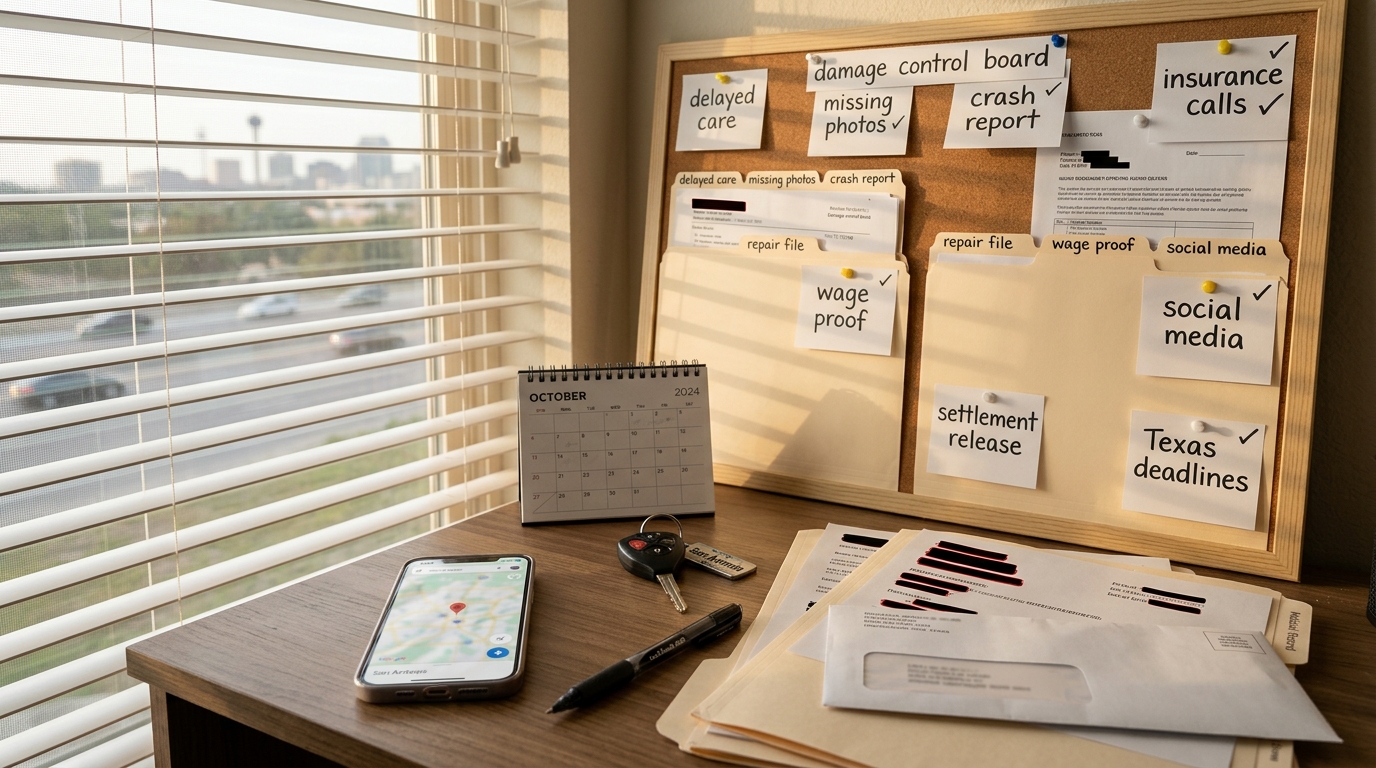
An injury claim can be damaged before a lawsuit is ever filed. Sometimes the problem is not that the accident was minor or the injury was not real. The problem is that the claim file has gaps: no photos, delayed medical care, lost witness names, confusing insurance statements, missing wage proof, or a settlement release signed too early.
After an accident in San Antonio, insurance companies may review every detail. They may look at what you said, when you got medical care, whether you followed treatment, what the crash report says, whether photos support your version, whether you saved bills, and whether Texas deadlines are getting close.
This guide explains common mistakes that hurt injury claims, why they matter, and what to do instead.
Quick Answer
Common mistakes that hurt injury claims include waiting too long to get medical care, failing to photograph the scene, losing witness information, not tracking the crash or incident report, guessing during insurance calls, giving recorded statements without preparation, signing broad medical authorizations, posting about the accident online, throwing away damaged property, failing to document missed work, ignoring available coverage, accepting a quick settlement, and waiting too long to ask about Texas deadlines.
If your claim already has one of these problems, do not assume it is ruined. A practical next step is to organize what you still have, identify missing records, and speak with an injury lawyer san antonio tx residents can contact about what evidence may still be preserved.
Key Takeaways
- Injury claims are often weakened by missing documentation, inconsistent statements, delayed treatment, and early settlement decisions.
- A crash report or incident report helps, but photos, witness details, medical records, bills, insurance letters, wage proof, and repair documents may also matter.
- Insurance companies may use treatment gaps, fault disputes, social media posts, broad medical authorizations, and missing records to reduce or deny a claim.
- Texas injury claims are time-sensitive, and shared-fault arguments can affect recovery.
- Mistakes can often be corrected or limited if you act quickly and rebuild the claim file with available proof.
The Claim Damage Control Board
Think of the injury claim as a board with warning lights. Each warning light represents a mistake that can weaken the file.
The goal is not panic. The goal is damage control.
Use this board:
| Warning Light | Why It Matters | What To Do Instead |
| Delayed medical care | Insurer may dispute injury cause | Get evaluated and keep records |
| Missing photos | Scene changes quickly | Save photos, videos, and camera notes |
| Lost witnesses | Fault becomes harder to prove | Collect names and phone numbers |
| No report tracking | Official records may be delayed | Save report numbers and request details |
| Guessing to insurance | Statements may be used later | Keep answers factual |
| Broad authorizations | Unrelated records may be requested | Ask what records are needed |
| Early settlement | Future care may be excluded | Review the full claim first |
| Missed deadlines | Rights may be lost | Ask about timing early |
A strong claim is not perfect. It is organized, consistent, and supported by records.
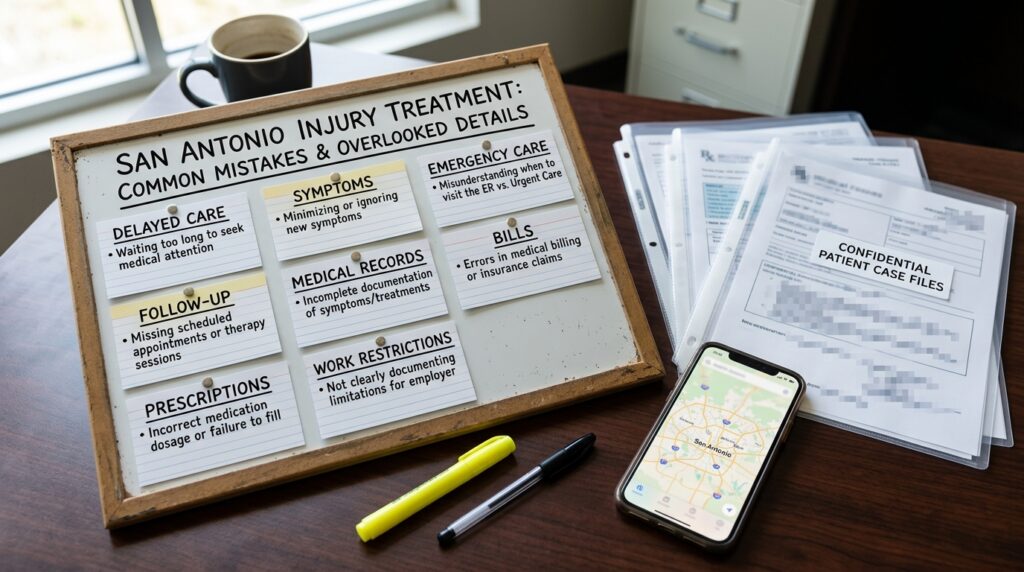
Mistake 1: Waiting Too Long to Get Medical Care
One of the most common mistakes is waiting to see whether pain goes away.
After a crash or fall, adrenaline can hide symptoms. Neck pain, back pain, headaches, dizziness, numbness, shoulder pain, knee pain, sleep problems, anxiety, and tingling may appear later or worsen over time.
Insurance companies may use delayed care to argue:
- You were not really hurt.
- The injury was caused by something else.
- The accident was not serious.
- The medical bills are unrelated.
- Treatment was unnecessary.
What to do instead:
- Get medical care when symptoms appear.
- Tell the provider when the accident happened.
- Describe all symptoms clearly.
- Follow discharge instructions.
- Keep follow-up appointments.
- Save medical records and bills.
- Track symptoms that appear later.
Helpful medical records may include emergency room records, urgent care notes, imaging reports, prescriptions, referral paperwork, physical therapy records, specialist notes, work restrictions, and medical bills.
Mistake 2: Saying “I’m Fine” Too Quickly
People often say “I’m fine” at the scene because they are embarrassed, shocked, polite, or trying to calm others. That statement may later create problems if symptoms appear after the adrenaline wears off.
A better approach is factual:
- “I’m shaken up.”
- “I need to check myself.”
- “I’m not sure yet.”
- “I may need medical care.”
- “I have pain, but I do not know how serious it is.”
Do not exaggerate injuries. But do not minimize symptoms before you know what is wrong.
Mistake 3: Failing to Photograph the Scene
Accident scenes change fast. Vehicles move, hazards are cleaned up, debris is cleared, witnesses leave, and camera footage may be overwritten.
If safe, photograph:
- Vehicle damage
- License plates
- Road layout
- Lane markings
- Traffic signs and signals
- Crosswalks
- Skid marks or debris
- Paint transfer
- Broken glass
- Weather and lighting
- Construction cones or lane shifts
- Nearby businesses
- Nearby cameras
- Visible injuries
- Damaged personal property
For unsafe property injuries, photograph:
- Spills
- Broken pavement
- Poor lighting
- Missing warnings
- Loose mats
- Damaged stairs
- Uneven sidewalks
- Parking-lot hazards
- Store aisles
- Apartment or hotel conditions
- Warning signs or lack of warnings
Do not put yourself in danger to take photos. Safety comes first. But if you can document the scene safely, those images may become important later.
Mistake 4: Losing Witness Information
Witnesses can help when fault is disputed. They may confirm a red-light violation, sudden lane change, speeding, a hazard, poor lighting, a fall condition, or the other party’s behavior.
Ask witnesses for:
- Name
- Phone number
- Email address
- What they saw
- Where they were standing or driving
- Whether they took photos or video
Witnesses may include other drivers, passengers, pedestrians, cyclists, store employees, apartment staff, hotel employees, restaurant workers, security guards, parking attendants, rideshare passengers, and delivery drivers.
Do not rely on police or a business to collect every witness. Preserve what you can.
Mistake 5: Not Looking for Cameras
Camera footage can disappear quickly. Many systems overwrite video after a short period.
Potential camera sources include:
- Dashcams
- Doorbell cameras
- Gas station cameras
- Restaurant cameras
- Hotel cameras
- Apartment cameras
- Store cameras
- Parking garage cameras
- Security gate cameras
- Rideshare or delivery app records
- Commercial vehicle cameras
- Truck electronic data
- Nearby business cameras
Write down the camera location, business name, address, and direction the camera faced. If you cannot request the footage yourself, preserve the information so it can be followed up quickly.
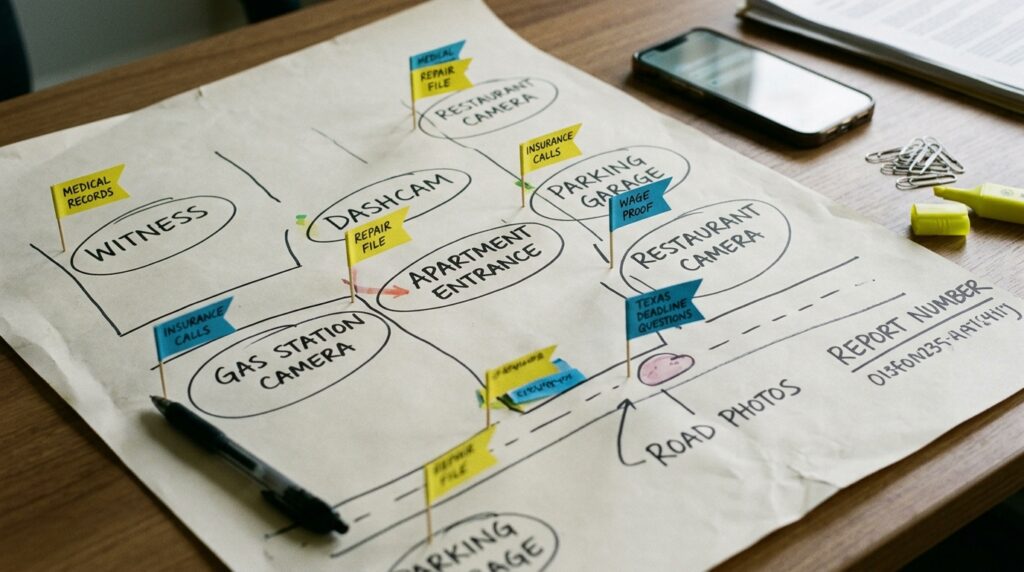
Mistake 6: Failing to Track the Crash Report or Incident Report
A report can help create an official record, but it may not be available immediately and may not contain every fact.
For motor vehicle crashes, TxDOT is the custodian of Texas crash records and provides eligible requesters access to Texas Peace Officer’s Crash Reports through the Crash Report Online Purchase System. San Antonio Police Department materials also include traffic accident report request forms.
Save:
- Report number
- Responding agency
- Officer name, if known
- Crash date
- Crash time
- Crash location
- Driver and vehicle information
- Insurance information
- Witness information
- Citation details, if any
For property injuries, ask whether the business, apartment, hotel, restaurant, store, or property manager made an incident report. If they will not give you a copy, write down who took the report, when it was made, and what was reported.
A report helps, but it is not the entire claim. Your photos, medical records, repair estimates, witness details, and insurance letters may be just as important.
Mistake 7: Guessing During Insurance Calls
Insurance adjusters may ask direct questions soon after an accident. Some questions are routine. Others can become problematic if you guess.
Avoid guessing about:
- Speed
- Distance
- Time
- Visibility
- Vehicle movement
- Fault
- Injury severity
- Future medical care
- Whether you are fully recovered
- What treatment will cost
If you do not know, say you do not know.
Keep answers factual:
- Date
- Location
- Vehicles involved
- Police response
- Medical care
- Claim number
- Basic contact information
- Where the vehicle was towed or repaired
Keep a claim log with the adjuster’s name, company, phone number, email address, date of the call, and what was discussed.
Mistake 8: Giving a Recorded Statement Without Understanding the Risk
A recorded statement may be compared against police reports, medical records, witness statements, photos, repair notes, and later testimony.
A statement can hurt the claim if you:
- Guess about facts
- Minimize symptoms
- Admit fault without context
- Say treatment is finished when it is not
- Forget important details
- Use unclear wording
- Give inconsistent information
- Answer questions you do not understand
Before giving a recorded statement, understand who is asking, why it is needed, whether your policy requires cooperation, whether the other insurer is asking, and what topics will be covered.
Mistake 9: Signing Broad Medical Authorizations
Insurance companies may ask for medical authorizations. Some requests are limited. Others may be broad enough to reach unrelated medical history.
Be careful with authorizations that allow access to:
- Unrelated providers
- Old injuries
- Entire medical history
- Mental health records unrelated to the claim
- Pharmacy records unrelated to the accident
- Records before the relevant time period
- Any provider without limits
Ask what records are needed and whether the request can be limited to accident-related treatment.
Mistake 10: Ignoring Your Own Insurance Coverage
Many people focus only on the other driver’s insurance. That can be a mistake.
Your own policy may matter if:
- The other driver has no insurance
- The other driver does not have enough insurance
- The other driver fled
- Medical bills are immediate
- You need vehicle repairs
- You need a rental car
- The other insurer delays
- Fault is disputed
Coverage that may matter includes:
- Personal injury protection
- Medical payments coverage
- Uninsured motorist coverage
- Underinsured motorist coverage
- Collision coverage
- Rental reimbursement
- Health insurance
Do not assume there is no coverage until you review the policy, declarations page, and claim letters.
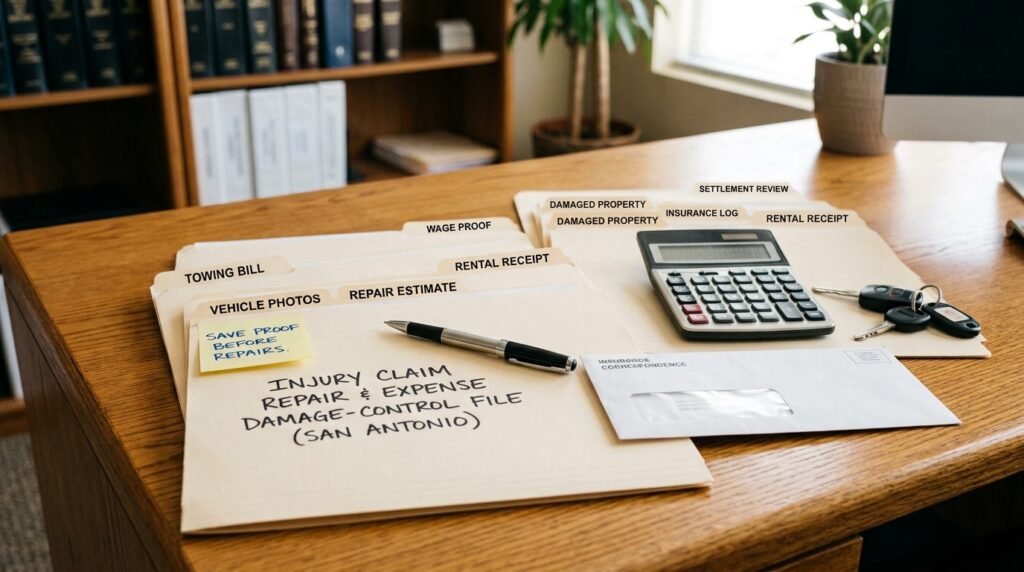
Mistake 11: Repairing the Vehicle Before Documenting Damage
Vehicle repairs can erase evidence. Before repairs, photograph:
- All sides of the vehicle
- Close-ups of impact areas
- Broken lights
- Paint transfer
- Wheel damage
- Airbag deployment
- Interior damage
- Child seats
- Damaged personal property
- Odometer and dashboard warnings, if relevant
Save repair estimates, supplemental estimates, body shop invoices, total-loss paperwork, rental receipts, towing bills, storage bills, and insurer repair communications.
Insurance companies may compare injuries to vehicle damage. Detailed repair documentation can help explain the physical impact.
Mistake 12: Throwing Away Damaged Property
Damaged property may help show the severity or mechanics of an accident.
Do not throw away:
- Child seats
- Helmets
- Shoes involved in a fall
- Torn clothing
- Broken glasses
- Damaged phones
- Bike parts
- Motorcycle gear
- Vehicle parts
- Medical braces or equipment
- Receipts for damaged items
Photograph and preserve damaged items when possible.
Mistake 13: Not Documenting Missed Work and Daily Impact
Medical bills do not tell the whole story. Injuries can affect work, transportation, sleep, childcare, household tasks, and daily routines.
Save:
- Pay stubs
- Timesheets
- Employer letters
- Missed-shift confirmations
- Work restriction notes
- Tax records
- Contractor invoices
- Business income records
- Proof of used sick time or vacation time
- Reduced-duty notes
- Out-of-pocket receipts
- Medical travel receipts
- Parking receipts for appointments
- Childcare receipts related to appointments
- Receipts for help at home
A short recovery journal can also help. Track pain levels, sleep problems, mobility limits, headaches, medication side effects, missed activities, difficulty driving, and changes in family responsibilities.
Keep it factual and consistent.
Mistake 14: Posting About the Accident Online
Social media posts can create problems. Insurance companies may review public posts, photos, location tags, comments, and activity that appear inconsistent with the injury claim.
Avoid posting:
- Accident details
- Injury updates
- Photos from the crash
- Comments about fault
- Comments about settlement
- Jokes about the accident
- Photos that can be misunderstood
- Check-ins during recovery
- Arguments with the other party
Even innocent posts can be taken out of context. It is safer to keep claim details offline.
Mistake 15: Missing Medical Appointments or Ignoring Treatment Instructions
Insurance companies may argue that missed appointments show the injury was not serious.
Avoid:
- Skipping follow-up care
- Missing therapy without explanation
- Stopping treatment without medical guidance
- Ignoring referrals
- Failing to fill prescriptions
- Not reporting worsening symptoms
- Not asking for work restrictions when needed
If you miss an appointment for a real reason, document why and reschedule. Treatment consistency matters.
Mistake 16: Accepting the First Settlement Offer Too Quickly
A quick settlement may not include the full value of the claim.
Before accepting, ask:
- Is treatment complete?
- Are all medical bills included?
- Is future care expected?
- Are lost wages included?
- Are repair and rental issues separate?
- Are liens or reimbursement claims possible?
- Does the release cover all claims?
- Does it release only one party or multiple parties?
- Does it include unknown injuries?
- Is the payment final?
A settlement release can end the claim. Once signed, you may not be able to return later for additional medical bills, lost wages, or future symptoms.
Mistake 17: Waiting Too Long to Ask About Deadlines
Texas injury claims are time-sensitive. In many cases, a personal injury lawsuit must be brought not later than two years after the day the cause of action accrues under Texas Civil Practice and Remedies Code Section 16.003.
Some claims may involve shorter notice issues. If a governmental unit may be involved, Texas Civil Practice and Remedies Code Section 101.101 provides that a governmental unit is entitled to receive notice of a claim under the Texas Tort Claims Act not later than six months after the incident. City charter or ordinance notice rules may also matter in some cases.
Texas law also affects recovery when fault is disputed. Under Texas Civil Practice and Remedies Code Section 33.001, a claimant may not recover damages if their percentage of responsibility is greater than 50 percent.
Do not wait until the deadline is close. Evidence can disappear long before the legal deadline arrives.
Mistake 18: Assuming Fault Is Obvious
You may know what happened, but the insurance company may still dispute fault.
Insurers may argue:
- You were partly responsible
- Another driver caused the crash
- A hazard was open and obvious
- You were distracted
- You delayed medical care
- The crash did not cause the injury
- The vehicle damage was minor
- Witnesses are missing
- Statements are inconsistent
Evidence is especially important when fault is disputed. Preserve photos, witness details, camera notes, reports, medical records, and repair documents early.
San Antonio Claim Damage Control Checklist
Use this checklist if you are worried a mistake has already happened.
If You Delayed Medical Care
- Get evaluated now if symptoms continue
- Explain when the accident happened
- Save all medical records
- Track symptoms in a timeline
- Follow medical instructions
If You Did Not Take Photos
- Photograph your vehicle or injury now
- Photograph damaged property
- Write down the scene layout
- Identify nearby cameras
- Ask witnesses for any photos or videos
If You Lost Witness Details
- Review texts, calls, photos, and notes
- Check police or incident reports
- Ask passengers what they remember
- Identify nearby businesses or employees
If You Talked to Insurance
- Write down what was said
- Save claim numbers and adjuster names
- Request future communication in writing
- Avoid guessing in later conversations
If You Received Settlement Papers
- Do not sign until you understand the release
- Confirm treatment status
- Review medical bills and wage loss
- Ask whether future care is included
- Check whether the release affects all claims
If You Are Worried About Deadlines
- Write down the accident date
- Identify every possible responsible party
- Ask whether a government vehicle, public property, or public employee may be involved
- Ask about Texas deadlines early
When Legal Guidance May Be Useful
Not every claim requires a lawyer. But legal guidance may be useful when mistakes, missing records, disputed fault, or insurance pressure create risk.
Consider asking for legal guidance if:
- You were injured
- Medical treatment is ongoing
- You delayed care but symptoms continue
- Fault is disputed
- The insurer blames you
- You gave a recorded statement
- You signed or received broad medical authorizations
- Camera footage may exist
- Witnesses need to be contacted
- The other driver fled
- The other driver had no insurance
- A commercial vehicle was involved
- A rideshare or delivery driver was involved
- A child was injured
- A loved one died
- You received a low settlement offer
- You are close to a deadline
- A government vehicle or public property issue may be involved
A lawyer may help organize the record, identify missing evidence, review insurance coverage, respond to fault arguments, communicate with insurers, and explain Texas timing issues.
FAQ
What is the biggest mistake after an injury accident?
One of the biggest mistakes is delaying medical care while symptoms continue. Insurance companies often use delayed treatment to argue that the injury was not serious or was not caused by the accident.
Can missing photos hurt my injury claim?
Yes. Photos can show vehicle damage, hazards, road layout, lighting, signs, debris, and other conditions before the scene changes.
Is it bad to talk to the insurance adjuster?
Not always. You may need to provide basic facts, but avoid guessing, admitting fault, minimizing injuries, or giving broad recorded statements without understanding the risk.
Should I give a recorded statement?
Be careful. Recorded statements may be compared against medical records, reports, photos, witnesses, and later statements. Understand who is asking and why before agreeing.
Can social media hurt an injury claim?
Yes. Posts, photos, comments, and location tags can be taken out of context and used to question injury severity or credibility.
What if I already made a mistake?
A mistake does not always ruin a claim. Start damage control: organize records, write a timeline, preserve what evidence remains, request missing documents, and ask about legal options.
Why should I keep medical bills and records?
Medical records and bills help show symptoms, diagnosis, treatment, costs, work restrictions, and the timeline connecting the injury to the accident.
Why should I save damaged property?
Damaged property may help show impact, injury mechanics, or loss. Items like helmets, shoes, child seats, broken glasses, torn clothing, and damaged phones may matter.
How long do I have to file a personal injury lawsuit in Texas?
In many Texas injury cases, the general deadline is two years from when the cause of action accrues. Some claims may involve shorter notice rules or different deadlines.
Is this article legal advice?
No. This article is for general informational purposes only. Anyone dealing with a specific accident or injury claim should speak with a qualified legal professional about their situation.
Final Thoughts
Most injury-claim mistakes are preventable. The strongest approach is simple: get medical care, preserve photos, save witness information, track reports, keep insurance communication factual, document expenses, avoid social media posts about the claim, and review settlement paperwork carefully.
If a mistake has already happened, focus on damage control. Rebuild the record, preserve what remains, organize your proof, and ask questions before the claim is weakened further.