

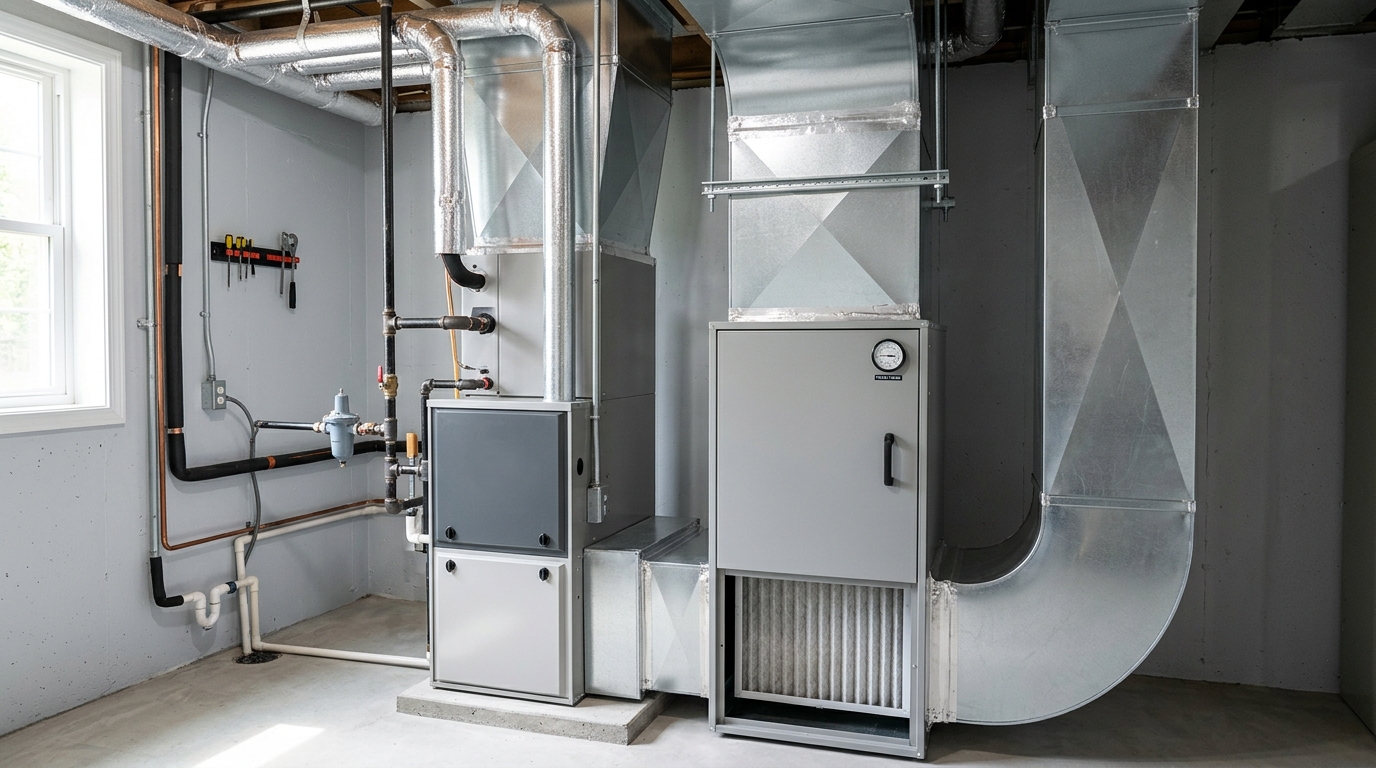
Indoor air contains particles that come from both inside and outside the home. Dust, pollen, pet dander, fibers, cooking particles, and other airborne material can circulate through living spaces and, in homes with forced-air heating and cooling, repeatedly pass through the HVAC system.
A whole-home filtration system is designed to capture some of those particles as air circulates through the equipment.
Unlike portable air cleaners that primarily treat individual rooms, whole-home filtration works within the home’s central HVAC system. That can make it an attractive option for homeowners who want centralized filtration across multiple conditioned spaces.
However, choosing an air filtration system involves more than purchasing the filter with the highest efficiency rating. Filter performance, surface area, pressure drop, HVAC blower capability, duct design, installation quality, and maintenance all affect how well the system performs.
Quick Answer
A whole-home air filtration system captures airborne particles as return air passes through the central HVAC system. More efficient filters can capture smaller particles, but the filtration system must be compatible with the HVAC equipment’s airflow requirements.
The best system balances particle capture, airflow, filter capacity, maintenance requirements, and HVAC compatibility rather than simply maximizing the filter’s efficiency rating.
Key Takeaways
- Whole-home filtration works through a central forced-air HVAC system.
- Filters vary substantially in particle-capture performance.
- MERV ratings help compare filter efficiency.
- A higher MERV rating is not automatically appropriate for every HVAC system.
- Filter surface area can affect airflow resistance and service life.
- Proper filter fit helps reduce air bypass around the media.
- Filters require regular inspection and replacement.
- Filtration should be part of a broader indoor air quality strategy.
What Is a Whole-Home Air Filtration System?
A whole-home filtration system is installed within or alongside a home’s central heating and cooling equipment.
As return air travels back toward the furnace or air handler, it passes through filtration media before being heated or cooled and redistributed through the duct system.
Depending on the filtration product, the system may capture varying amounts of:
- Household dust
- Pollen
- Pet dander
- Textile fibers
- Some airborne particles
- Other particulate matter
The system’s effectiveness depends on the filter itself and how much household air actually passes through it.
Whole-home filtration is therefore closely connected to HVAC airflow and system operation.
How Whole-Home Filtration Works
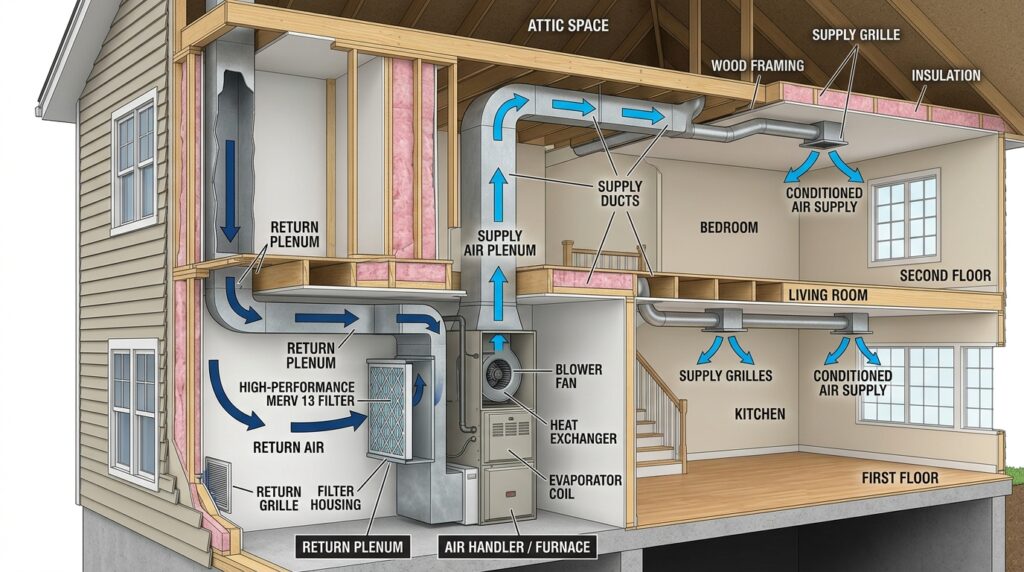
A typical forced-air system follows a basic circulation process:
1. Return air enters the duct system.
Air from occupied rooms travels through return grilles and ductwork toward the furnace or air handler.
2. Air passes through the filter.
Particles that the filtration media is capable of capturing are removed from the airstream.
3. The HVAC system conditions the air.
Depending on the season, the equipment heats or cools the filtered air.
4. Conditioned air returns to the home.
The blower distributes the air through supply ductwork.
This process repeats whenever the HVAC blower operates.
That last point is important: a whole-home filtration system only filters air that actually passes through the HVAC system.
Whole-Home Filtration vs. Standard Furnace Filters
Many homes already contain a basic furnace or air-handler filter.
So what makes whole-home filtration different?
Basic filters are often selected primarily to protect HVAC equipment from larger debris. Higher-performance filtration systems may be designed to capture a broader range of airborne particles.
Differences may involve:
- Filtration efficiency
- Media depth
- Filter surface area
- Cabinet design
- Pressure drop
- Replacement frequency
A deeper media filter, for example, can provide substantially more filtration surface area than some thin filters.
That additional surface area can help provide improved particle capture while managing airflow resistance, depending on the product and system design.
Understanding MERV Ratings
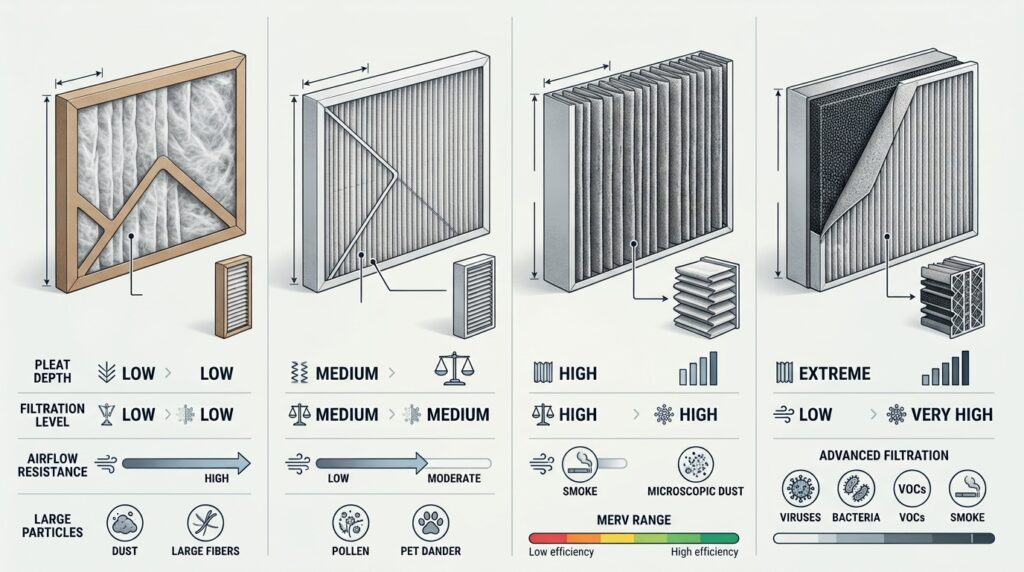
One of the most common terms homeowners encounter when comparing HVAC filtration is MERV.
MERV stands for Minimum Efficiency Reporting Value.
The rating provides a standardized method for comparing a filter’s ability to capture particles within defined size ranges.
Generally, higher MERV ratings indicate greater particle-capture efficiency.
However, homeowners should not interpret MERV as a simple scale where the highest number is always the best choice.
The EPA recommends considering filtration efficiency together with HVAC system compatibility and generally advises choosing the highest-efficiency filter the system can accommodate.
Homeowners can review the EPA’s air cleaner and HVAC filter guidance for additional information.
Why the Highest MERV Filter Isn’t Always the Right Filter
Higher-efficiency filtration can increase resistance to airflow.
In HVAC terminology, that resistance contributes to static pressure.
If a filter creates more resistance than the system can accommodate, potential consequences may include:
- Reduced airflow
- Increased blower workload
- Comfort problems
- Heating or cooling performance issues
- Equipment operating problems
This does not mean higher-efficiency filters are inherently bad for HVAC systems.
It means filtration should be selected as part of the HVAC design.
A properly designed system may accommodate a high performance air filter while maintaining appropriate airflow.
Filter Surface Area Matters
Two filters can provide different airflow characteristics even when they have similar filtration ratings.
One reason is surface area.
Deep pleated media can provide substantially more filtration surface than a thin, flat filter of similar face dimensions.
Greater surface area can potentially:
- Reduce airflow resistance
- Increase dust-holding capacity
- Extend useful filter life
- Support higher filtration performance
Actual performance varies by filter design, so homeowners should evaluate manufacturer specifications rather than relying only on filter thickness.
Pressure Drop Is an Important HVAC Consideration
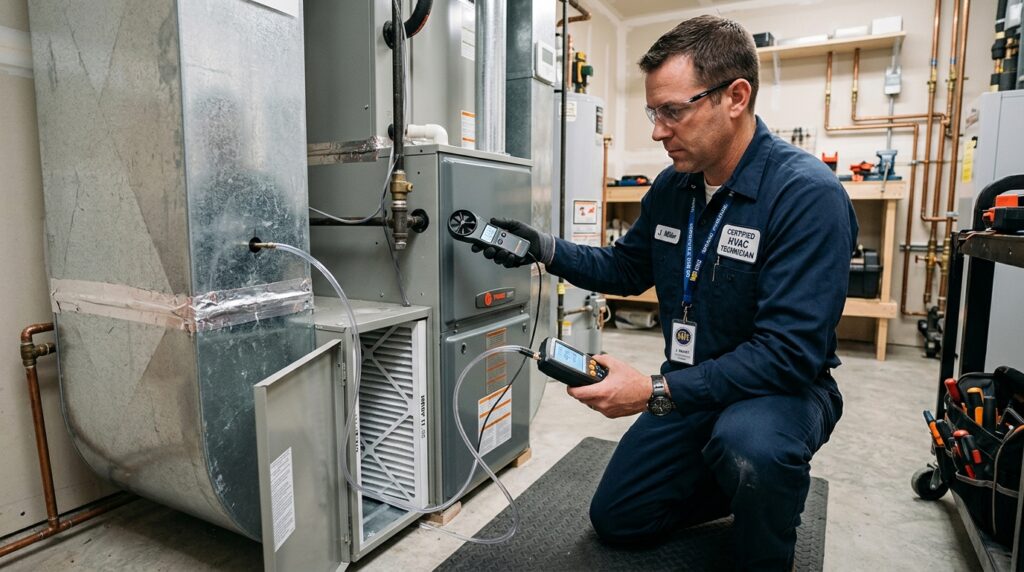
When air moves through a filter, the filter creates resistance.
This is commonly described as pressure drop.
As a filter accumulates particles, pressure drop may increase.
If resistance becomes excessive, airflow can decline.
That is why filter condition affects more than indoor air quality. It can also influence HVAC system efficiency and equipment performance.
Professional HVAC evaluation can help determine whether a filtration upgrade is compatible with:
- Blower capacity
- Existing ductwork
- Return-air configuration
- Filter cabinet dimensions
- Overall static pressure
Filter Fit Is Just as Important as Filter Rating
A highly efficient filter cannot perform as intended if significant amounts of air bypass the filtration media.
Common problems can include:
- Incorrect filter dimensions
- Gaps around the filter
- Damaged filter racks
- Improper installation
- Incorrect filter orientation
Air naturally follows available pathways.
If gaps around the filter provide an easier path than moving through the media, some air may bypass filtration.
A properly fitted cabinet helps ensure that return air actually passes through the filter.
How Often Should a Whole-Home Filter Be Replaced?
There is no universal replacement interval appropriate for every system.
Filter life depends on factors such as:
- Filter design
- Media depth
- HVAC runtime
- Household occupancy
- Pets
- Indoor dust levels
- Renovation activity
- Outdoor conditions
A filter used in a home with several pets and extensive HVAC runtime may load faster than the same filter used in a lower-occupancy home.
Homeowners should therefore follow manufacturer guidance and inspect filters regularly.
Don’t Judge Filter Condition Only by Color
A filter becoming gray does not necessarily mean it has reached the end of its useful life.
Likewise, a filter that looks relatively clean may still require replacement according to its operating conditions or manufacturer recommendations.
Visual inspection can be useful, but homeowners should also consider:
- Time in service
- HVAC runtime
- Airflow changes
- Manufacturer specifications
- Household conditions
For higher-capacity filtration systems, professional pressure measurements can provide additional information about system resistance.
Can Better Filtration Improve HVAC Efficiency?
This question requires an important distinction.
Installing a more efficient filter does not automatically make the HVAC equipment more energy efficient.
In fact, an incompatible filter that creates excessive resistance could negatively affect airflow.
The potential HVAC benefit comes from appropriate filtration helping protect system components from particle accumulation while maintaining suitable airflow.
A properly designed filtration system should therefore support overall system operation rather than interfere with it.
Whole-Home Filtration Can Help Protect HVAC Equipment
One purpose of HVAC filtration is protecting internal components from debris.
Depending on system design, filtration can help reduce particle accumulation on components such as:
- Blower assemblies
- Heating equipment
- Cooling coils
Cleaner components can support normal heat transfer and airflow.
However, filtration does not eliminate the need for professional HVAC maintenance.
Filters and maintenance perform complementary roles.
What Whole-Home Filtration Cannot Do
Whole-home filtration is useful, but homeowners should understand its limitations.
A particle filter does not automatically solve problems involving:
- Excess indoor humidity
- Low winter humidity
- Carbon monoxide
- Radon
- Moisture intrusion
- Every gaseous pollutant
- Mold growing on wet building materials
- Inadequate ventilation
Different indoor air problems require different solutions.
For example, moisture problems require moisture control. Carbon monoxide concerns require appropriate combustion safety, venting, and alarms. Radon requires testing and, when necessary, appropriate mitigation.
This is why filtration should be considered one part of a broader indoor air quality strategy.
Whole-Home Filtration vs. Portable HEPA Air Cleaners
Portable air cleaners and whole-home filtration serve overlapping but different purposes.
A whole-home system can filter air circulating throughout central ductwork.
A portable HEPA air cleaner can provide concentrated particle filtration within a specific room.
Portable units may be useful for:
- Bedrooms
- Home offices
- Specific occupied areas
- Homes without central ductwork
Whole-home systems may be preferable when homeowners want centralized filtration across multiple rooms.
Some households may benefit from both approaches.
Does the HVAC Fan Need to Run Continuously?
Because whole-home filtration only works when air passes through the filter, homeowners sometimes assume the HVAC blower should operate continuously.
Continuous fan operation increases the amount of air passing through the filter, but it also increases blower runtime and electricity use.
Whether continuous circulation makes sense depends on:
- HVAC equipment
- Blower efficiency
- Filtration objectives
- Comfort needs
- Energy considerations
Homeowners should evaluate circulation settings based on their specific equipment rather than assuming continuous operation is always necessary.
Professional Filtration Upgrades Should Start With Airflow
Before installing higher-performance filtration, the existing HVAC system should be evaluated.
Useful considerations include:
- Current filter dimensions
- Return-air capacity
- Blower capability
- Existing static pressure
- Duct restrictions
- Available cabinet space
This helps determine whether the existing system can accommodate the desired filter or whether modifications would provide better performance.
The objective is not simply more filtration.
It is better filtration while maintaining appropriate HVAC operation.
How to Choose the Right Whole-Home Air Filter
Choosing filtration should begin with the HVAC system rather than the filter package.
Homeowners should consider:
- Existing filter dimensions
- Furnace or air-handler requirements
- Blower capability
- Return-air capacity
- Current static pressure
- Desired particle filtration
- Filter replacement cost
- Maintenance frequency
EPA guidance recommends using at least MERV 13—or the highest efficiency the system’s fan and filter slot can accommodate—when upgrading residential HVAC filtration. Compatibility matters because the system still needs adequate airflow.
A professional assessment may therefore be appropriate before installing a substantially different high performance air filter.
MERV vs. HEPA: What’s the Difference?
MERV and HEPA are related to particle filtration, but they should not be treated as interchangeable ratings.
MERV is commonly used to compare filters for furnaces and central HVAC systems. The scale evaluates particle-capture performance across defined particle-size ranges.
HEPA, or High Efficiency Particulate Air, describes filtration capable of theoretically removing at least 99.97% of airborne particles at 0.3 microns under its defined test conditions.
That does not mean homeowners should attempt to install a HEPA filter directly into a conventional furnace filter slot.
True HEPA filtration can create substantially different airflow requirements. Residential applications may instead use purpose-designed equipment or portable HEPA air cleaners.
The appropriate choice depends on what the HVAC system was designed to accommodate.
Does Every Home Need MERV 13?
Not necessarily.
EPA currently recommends MERV 13 or as high as the system can accommodate when homeowners want to upgrade HVAC particle filtration. But the phrase “as high as your system can accommodate” is critical.
An existing system may have:
- Limited return-air capacity
- A restrictive filter rack
- An older blower
- Existing high static pressure
- Duct restrictions
In those situations, modifications may be needed before substantially increasing filtration resistance.
A lower-resistance configuration with greater filter surface area may sometimes provide a better solution than simply placing a restrictive filter into the existing slot.
Homes With Pets May Need More Frequent Filter Attention
Pets can increase the amount of hair, dander, and other material entering the home’s air and HVAC system.
Homes with multiple pets may therefore need filters inspected more frequently.
Other factors that can increase filter loading include:
- High household occupancy
- Renovation work
- Extensive HVAC runtime
- Outdoor dust
- Frequent door opening
- Certain hobbies or household activities
This does not necessarily mean the filtration system itself needs to be replaced.
It may simply mean that maintenance intervals need to reflect actual household conditions.
Can Whole-Home Filtration Help With Allergens?
HVAC filtration can capture certain airborne particles, including pollen and some pet-related particles, depending on filter performance.
However, filtration should not be presented as a guaranteed treatment for allergies or asthma.
EPA notes that studies of portable HEPA air cleaners have found improvements in some allergy or asthma symptoms, but results are not universal and improvements may be modest.
For households concerned about airborne particles, filtration may be one part of a broader strategy that also includes:
- Source control
- Regular cleaning
- Appropriate ventilation
- Moisture management
- Targeted portable filtration
Medical symptoms should be discussed with an appropriate healthcare professional rather than diagnosed through an HVAC assessment.
Whole-Home Filtration vs. Portable HEPA for Bedrooms
A homeowner does not necessarily have to choose one or the other.
Whole-home filtration treats air passing through the central HVAC system.
Portable HEPA air cleaners provide localized filtration and can be selected for specific spaces such as bedrooms or home offices.
EPA recommends choosing portable units with a Clean Air Delivery Rate, or CADR, appropriate for the size of the room.
This creates several possible strategies:
Central filtration only: useful when whole-home particle control is the primary objective.
Portable filtration only: useful for targeted rooms or homes without central forced-air systems.
Both: useful when homeowners want general whole-home filtration plus additional filtration in specific occupied spaces.
What About Electronic Air Cleaners?
Some residential filtration products use electronic technologies rather than relying exclusively on conventional mechanical filter media.
These technologies can differ significantly in design and performance.
Homeowners should evaluate:
- Particle-removal performance
- Maintenance requirements
- Electrical consumption
- Replacement components
- Compatibility with existing HVAC equipment
- Potential ozone production
EPA specifically advises avoiding air-cleaning devices that intentionally produce ozone, because ozone is a lung irritant. Some electronic technologies may also have the potential to produce ozone depending on their design.
Equipment should therefore be evaluated based on documented performance rather than marketing terminology alone.
Filtration Does Not Eliminate the Need for Source Control
A common mistake is treating an air cleaner as permission to ignore the source of indoor pollutants.
For example, filtration cannot correct:
- Active moisture intrusion
- Mold growing on wet materials
- Improperly vented combustion appliances
- Radon entering through the foundation
- Excessive indoor pollutant generation
EPA describes filtration as a supplement to source control and ventilation rather than a replacement for those measures.
If a pollutant source can reasonably be removed or reduced, addressing it directly should remain part of the indoor air quality strategy.
Better Filtration Does Not Fix Mold Problems
This deserves particular attention.
An air filtration system may capture some airborne particles associated with mold, but it does not remove the moisture source allowing mold to grow.
EPA guidance emphasizes that mold problems require moisture control and appropriate cleanup; filtration alone does not resolve the underlying cause.
Persistent moisture may originate from:
- Plumbing leaks
- Foundation water
- Roof leaks
- Condensation
- Inadequate ventilation
- Building-envelope problems
Those causes should be corrected directly.
How Much Does Whole-Home Filtration Maintenance Cost?
Maintenance costs vary by system.
The primary recurring expense for most media-based filtration systems is replacement filters.
Costs depend on:
- Filter dimensions
- MERV rating
- Media depth
- Brand and product design
- Replacement frequency
- Availability
Higher-capacity filters may cost more per replacement but can sometimes remain in service longer than thinner filters.
Homeowners should therefore compare annual ownership cost, not simply the purchase price of one replacement filter.
Electronic filtration equipment may have different maintenance requirements involving cleaning, electrical components, or replacement cells.
Common Whole-Home Filtration Mistakes
Mistake 1: Buying Based Only on MERV Rating
MERV matters, but so do airflow resistance, filter area, and HVAC compatibility.
Mistake 2: Ignoring Filter Fit
Air bypassing around the filter reduces effective filtration.
Mistake 3: Forgetting Filter Replacement
EPA notes that filters require regular replacement and overloaded filters will not perform properly.
Mistake 4: Assuming Filtration Removes Every Pollutant
Most residential HVAC filters primarily address particles, not every gaseous contaminant.
Mistake 5: Ignoring Existing Airflow Problems
Installing more restrictive filtration into an HVAC system already experiencing airflow problems can create additional performance concerns.
Mistake 6: Assuming Expensive Means Appropriate
A sophisticated filtration product still needs to match the home’s actual needs and HVAC capabilities.
Can a Better Filter Reduce Dust in the Home?
Improved filtration can help capture airborne dust particles passing through the HVAC system.
However, household dust also comes from sources such as:
- Textiles
- Skin particles
- Outdoor soil
- Pets
- Open doors
- Household activities
Much of that material settles onto surfaces before reaching the HVAC return system.
Better filtration may therefore reduce some circulating particulate matter without eliminating household dust entirely.
Regular cleaning and source control remain useful.
Should the HVAC Fan Run More Often for Better Filtration?
Whole-home filtration only occurs while air is moving through the filter.
Running the blower for longer periods can therefore increase the volume of air being filtered. EPA notes, however, that longer HVAC fan runtime increases electricity consumption and may have other operational implications.
The appropriate fan strategy depends on:
- Blower efficiency
- Equipment configuration
- Filtration objectives
- Cooling-season humidity
- Energy costs
Continuous fan operation should not automatically be assumed to be necessary.
Can Filtration Affect HVAC System Efficiency?
Yes—but the relationship needs to be understood correctly.
A high-performance filter does not inherently increase the rated efficiency of a furnace or air conditioner.
Instead, filtration affects how air moves through the system.
If the filter is properly selected, fitted, and maintained, it can support clean HVAC components while allowing appropriate airflow.
If filtration creates excessive resistance, system airflow and performance may suffer.
Protecting HVAC system efficiency therefore requires balancing filtration performance with system airflow.
Questions to Ask Before Upgrading Whole-Home Filtration
Before installing a different filtration system, homeowners may want to ask:
- What filter does the HVAC manufacturer allow?
- What is the current system static pressure?
- Can the existing blower support the proposed filter?
- Is the return ductwork adequately sized?
- What MERV rating is appropriate?
- How much filter surface area will the system provide?
- How frequently will filters need replacement?
- What will replacement filters cost?
- Will the new filter cabinet require duct modifications?
- How will airflow be verified after installation?
These questions help move the conversation beyond simply asking, “What’s the highest MERV filter available?”
When Does a Dedicated Filter Cabinet Make Sense?
Some homes use thin filters located in relatively small filter racks.
When homeowners want higher-performance filtration, a larger media cabinet may provide another option.
Depending on the design, deeper filtration media can offer:
- Greater surface area
- Greater particle-holding capacity
- Different pressure-drop characteristics
- Longer service intervals
Whether a cabinet upgrade is worthwhile depends on the existing ductwork, available installation space, blower capability, and filtration objectives.
Professional evaluation can determine whether modifying the filter configuration is more appropriate than simply changing the existing filter.
Choosing a Whole-Home Air Filtration Provider
A filtration recommendation should begin with the home and HVAC system—not a predetermined product.
When comparing providers, homeowners may want to consider whether they evaluate:
- Existing equipment
- Blower capability
- Return ductwork
- Static pressure
- Current filter configuration
- Household filtration objectives
- Ongoing maintenance requirements
A qualified provider should also be able to explain why a particular filter is appropriate and how it will affect airflow.
Homeowners may additionally review public business profiles when evaluating reported service experiences alongside technical qualifications.
The Best Filtration System Is a Balanced System
Whole-home filtration involves a tradeoff that is easy to overlook.
Homeowners want to capture more particles.
At the same time, the HVAC system needs adequate airflow.
Effective filtration therefore requires balancing:
Particle removal + airflow + filter capacity + system compatibility + maintenance.
Simply maximizing one variable can create problems elsewhere.
A properly selected high performance air filter should improve particle filtration while remaining appropriate for the HVAC system in which it operates.
Conclusion
Whole-home air filtration can be a valuable part of an indoor air quality strategy, particularly in homes with central forced-air heating and cooling.
But filtration effectiveness depends on considerably more than the MERV number printed on the filter.
Homeowners should consider:
- Particle-capture efficiency
- Filter dimensions
- Surface area
- Pressure drop
- HVAC blower capability
- Ductwork
- Filter fit
- Maintenance requirements
- Household air-quality goals
EPA guidance supports using MERV 13 or the highest-efficiency filter the HVAC system can accommodate when upgrading filtration, while also emphasizing that filtration supplements rather than replaces source control and ventilation.
For homeowners considering an upgrade, the objective should not simply be to install the strongest filter available.
It should be to create a filtration system that captures useful amounts of airborne particulate matter without compromising the airflow required for proper HVAC operation.
Frequently Asked Questions
What is a whole-home air filtration system?
A whole-home air filtration system is installed within a central HVAC system and filters air as it circulates through the return ductwork. It is designed to capture airborne particles before conditioned air is redistributed throughout the home.
Is a whole-home air filtration system better than a standard furnace filter?
It can be. Higher-performance filtration systems may provide greater particle capture, more filter surface area, and better dust-holding capacity than some basic filters. The correct choice depends on HVAC compatibility, airflow, and household needs.
What MERV rating should I use?
EPA guidance generally supports using MERV 13 or the highest-efficiency filter the HVAC system can accommodate. The key issue is compatibility, because overly restrictive filters can reduce airflow if the system is not designed for them.
Is a higher MERV rating always better?
No. Higher MERV ratings usually mean better particle capture, but they may also increase airflow resistance. The best filter balances filtration performance with proper system airflow.
What is the difference between MERV and HEPA?
MERV is commonly used to rate HVAC filters. HEPA describes a much higher level of particle filtration. True HEPA filtration may require specialized equipment because many standard residential HVAC systems are not designed for the resistance created by HEPA media.
Can a high-performance filter hurt my HVAC system?
Potentially, if it creates excessive airflow resistance. A properly selected high performance air filter should be matched to blower capacity, duct design, return airflow, and filter-cabinet configuration.
How often should whole-home filters be replaced?
Replacement frequency depends on filter type, media depth, HVAC runtime, pets, household occupancy, dust levels, and manufacturer recommendations. Filters should be inspected regularly rather than replaced according to one universal schedule.
Can whole-home filtration reduce dust?
It can help reduce airborne dust that passes through the HVAC system, but it will not eliminate all household dust. Regular cleaning and source control are still important.
Does whole-home filtration help with pet dander and pollen?
Yes, depending on filter efficiency. More effective filtration can capture some airborne pet dander, pollen, and other particles, but overall results depend on system airflow and how much air actually passes through the filter.
Can whole-home filtration improve HVAC system efficiency?
Filtration does not directly increase the rated efficiency of HVAC equipment. However, properly designed filtration can help protect equipment from particle accumulation. Protecting HVAC system efficiency requires maintaining appropriate airflow and changing filters before they become excessively loaded.
Is whole-home filtration enough to solve indoor air quality problems?
No. Filtration is only one part of indoor air quality management. Moisture problems, ventilation deficiencies, combustion concerns, radon, and some gaseous pollutants require different solutions.
Should I use a portable HEPA cleaner with whole-home filtration?
In some homes, yes. Whole-home filtration can provide centralized particle control, while a portable HEPA unit can provide additional filtration in a bedroom, office, or other frequently occupied room.