

A car accident can leave you with more questions than answers.
Your neck may feel stiff. Your back may hurt when you sit. Turning your head may be uncomfortable. Or you may feel fine immediately after the crash and notice symptoms later.
At that point, you may start searching for an auto accident chiropractor and wondering what chiropractic care actually involves.
Does it simply mean getting an adjustment?
Does everyone involved in a collision need chiropractic treatment?
How does a chiropractor determine whether care is appropriate?
And where does rehabilitation fit into the picture?
The answer starts with an important distinction:
Chiropractic care after an accident should follow an appropriate evaluation. It shouldn’t be assumed to be the right treatment for every injury.
What Is Auto Accident Chiropractic Care?
Auto accident chiropractic care generally refers to chiropractic evaluation and treatment for musculoskeletal complaints associated with a motor vehicle collision.
Chiropractors commonly assess musculoskeletal problems. According to the National Center for Complementary and Integrative Health, chiropractic care can involve patient history, examination, testing, development of a working diagnosis, treatment, and monitoring of progress.
That means the process isn’t necessarily:
Accident → adjustment → recovery
A more responsible approach is:
Accident → evaluation → determine appropriate care → monitor progress → adjust the plan as needed
That difference matters.
What Can Happen to the Body During a Collision?
A vehicle collision can subject the body to sudden forces.
Depending on the circumstances, different areas may become symptomatic.
Common complaints can involve:
- Neck stiffness
- Back pain
- Shoulder discomfort
- Muscle soreness
- Headaches
- Reduced range of motion
- Tingling or numbness
- Difficulty sitting
- Difficulty driving
- Difficulty returning to exercise
The presence of a symptom doesn’t automatically establish a particular diagnosis.
For example, neck pain could have several potential causes.
Back pain can also have different sources.
That’s why an evaluation matters before assuming what happened.
Symptoms May Develop Later
Some accident-related symptoms aren’t immediately obvious.
The CDC notes that concussion symptoms can appear right away or take hours or days to appear. Symptoms can affect physical well-being, thinking, emotions, and sleep.
This is one reason drivers shouldn’t use the first few minutes after a collision as the only measure of whether they’re injured.
If something changes later, pay attention to it.
When Should Emergency Care Come First?
Before considering routine chiropractic care, rule out situations that require urgent medical attention.
The CDC lists several concussion danger signs in adults, including:
- A headache that gets worse and doesn’t go away
- Repeated vomiting
- Weakness or numbness
- Decreased coordination
- Seizures
- Slurred speech
- Increasing confusion
- Unusual behavior
- Loss of consciousness
- Difficulty waking up
These symptoms require immediate emergency medical care.
Significant neurological symptoms following neck or back trauma should also receive appropriate medical evaluation.
An auto accident chiropractor should not be a substitute for emergency care when an emergency may be present.
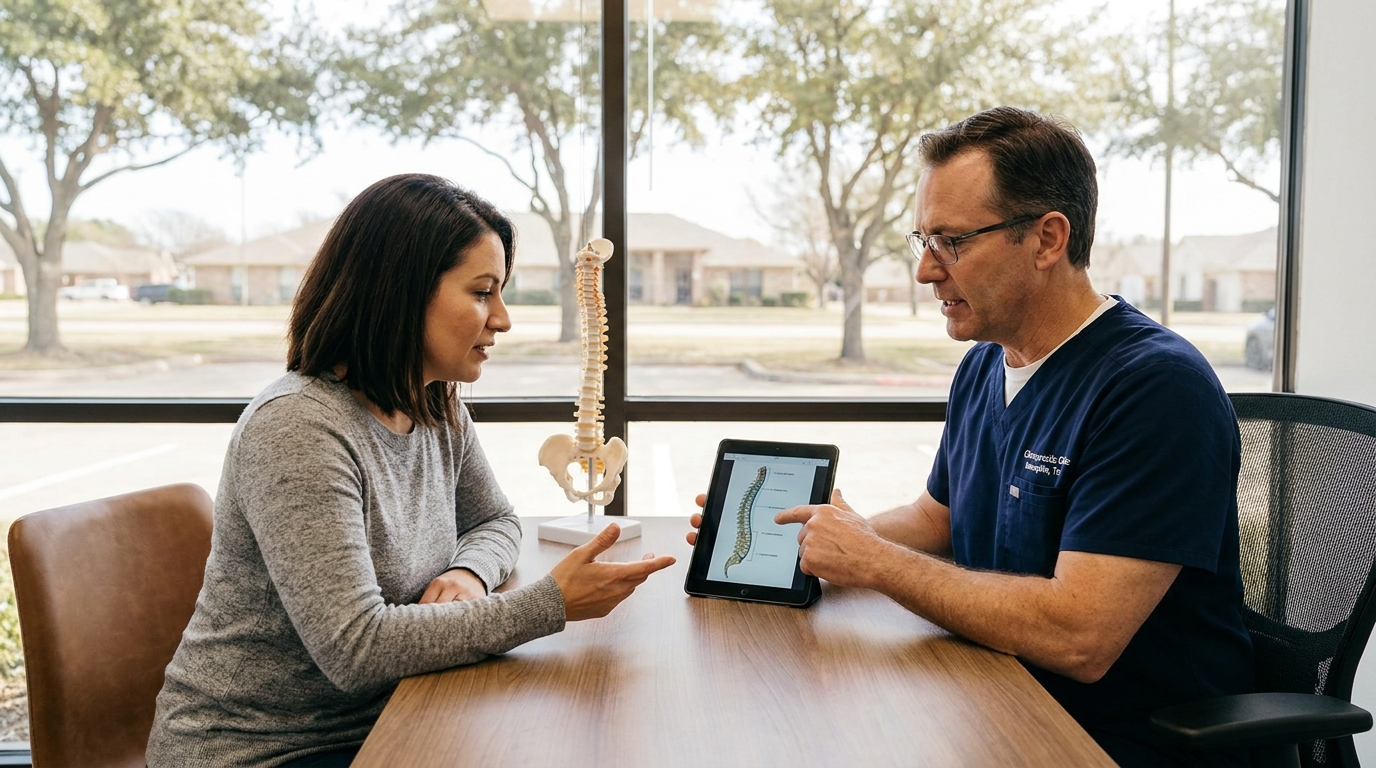
What Happens During a Chiropractic Evaluation?
One of the most useful questions to ask a potential provider is:
“What happens during the first appointment?”
An accident-related evaluation may consider:
Your Accident History
The provider may want to understand how the collision happened and when symptoms began.
Your Symptoms
Where do you hurt?
What makes the symptoms better or worse?
Have they changed since the accident?
Range of Motion
Can you move normally?
Is movement restricted or uncomfortable?
Strength and Sensation
Are there changes in strength, numbness, tingling, or sensation?
Functional Limitations
- Can you drive?
- Can you work?
- Can you sleep?
- Can you exercise?
- Can you perform normal household tasks?
These details help establish the bigger picture.
Why a Thorough History Matters
Two people can be involved in similar accidents and experience very different symptoms.
One person may have mild stiffness that resolves quickly.
Another may have persistent limitations affecting work and daily activities.
Medical history also matters.
NCCIH recommends that people considering spinal manipulation tell their practitioner about relevant health conditions and medications. It also recommends asking about the practitioner’s education, licensure, experience treating the condition, expected number of sessions, and costs.
So a good initial appointment should involve questions—not just treatment.
What Does a Chiropractic Adjustment Actually Mean?
The term “adjustment” is often used broadly, but chiropractic treatment can involve different techniques.
NCCIH describes spinal manipulation as a controlled thrust applied to a spinal joint. It distinguishes this from spinal mobilization, which involves movement within the joint’s natural range without a thrust.
Not every patient needs the same technique.
And not every patient should receive spinal manipulation.
The appropriate approach depends on the patient’s condition and the provider’s assessment.
What Does the Research Say?
It’s important to keep expectations realistic.
NCCIH reports that spinal manipulation may produce small improvements in pain and function for some adults with acute or chronic low-back pain. It also notes that evidence for neck pain is more limited and varies by condition and study quality.
This is useful context because it avoids two extremes:
“Chiropractic care fixes every accident injury.”
and
“Chiropractic care has no legitimate role in recovery.”
Neither statement accurately reflects the evidence.
For appropriate musculoskeletal conditions, chiropractic care may be one component of a broader conservative treatment plan.

Chiropractic Care Isn’t Just About Adjustments
A recovery plan can involve more than manual treatment.
Depending on the patient’s condition, care may also include:
- Mobility exercises
- Therapeutic exercise
- Strengthening
- Movement education
- Activity modification
- Rehabilitation
- Home exercises
- Functional progression
The exact combination should depend on the individual.
This is particularly important after a collision because the goal isn’t simply to make one body part feel better temporarily.
The broader goal is to help restore appropriate function.
Where Rehabilitation Fits
Suppose neck stiffness has made driving uncomfortable.
Simply reducing the immediate discomfort may not answer the larger question:
Can you safely and comfortably return to normal driving?
Or suppose back pain has affected your ability to sit at work.
The recovery process may need to address more than the symptom itself.
Rehabilitation may focus on:
- Range of motion
- Strength
- Endurance
- Coordination
- Movement control
- Functional activities
- Gradual return to normal routines
The appropriate program depends on the injury and should be individualized.

How Do You Know If You’re Improving?
Pain is one measure.
Function is another.
Ask yourself:
- Can I turn my head more easily?
- Can I sit through my commute?
- Can I work my normal schedule?
- Can I sleep comfortably?
- Can I walk farther?
- Can I return to appropriate exercise?
- Can I perform household tasks more easily?
NCCIH uses functional measures such as walking, standing, sleeping, and household activities to discuss how low back pain affects everyday life.
That concept can be useful after an accident too.
A recovery plan should ideally connect to the activities that matter in your daily life.
What If Symptoms Get Worse?
Recovery isn’t always perfectly linear.
You may feel better, only to notice symptoms after increasing your activity.
May return to work and discover that prolonged sitting remains difficult.
You may regain movement but still experience fatigue or discomfort.
Changes should be communicated to your healthcare provider.
For people recovering from a mild TBI or concussion, the CDC advises contacting a healthcare provider if symptoms don’t go away or become worse after returning to regular activities.
The important point is not to assume that every setback means the same thing.
A change in symptoms deserves attention and appropriate clinical judgment.
Safety Considerations
Like any healthcare approach, spinal manipulation has potential risks and isn’t appropriate for everyone.
NCCIH reports that temporary side effects can include increased pain or discomfort, stiffness, and headache. Serious complications are very rare, but the organization emphasizes thorough assessment and disclosure of relevant health conditions and medications.
Before receiving treatment, tell your provider about:
- Previous injuries
- Existing medical conditions
- Current medications
- Recent trauma
- Neurological symptoms
- Changes in strength
- Changes in sensation
Don’t omit information just because it seems unrelated.
Your provider needs the full picture to determine whether a particular treatment is appropriate.
How to Choose an Auto Accident Chiropractor
If you’re comparing providers in Mesquite, look beyond the words “auto accident chiropractor.”
Ask:
Does the provider evaluate before treating?
You want to understand the basis for the treatment plan.
Does the provider have experience with accident-related conditions?
Relevant experience can help the provider understand common post-collision concerns.
Is there a broader recovery plan?
Ask whether appropriate exercise or rehabilitation is available.
Is progress monitored?
Treatment shouldn’t simply continue indefinitely without assessing how you’re doing.
Does the provider communicate clearly?
You should understand what is being recommended and why.
Does the provider recognize when additional medical care is needed?
This is especially important after trauma.
Questions to Ask Before Starting Chiropractic Care
You can use these questions during your first consultation:
What will my initial evaluation include?
What might be contributing to my symptoms?
Is chiropractic care appropriate for my condition?
What techniques might you use?
Would rehabilitation or exercise be useful?
How will you monitor my progress?
How many visits might I need, and what determines that?
What should I expect to pay?
What symptoms would require additional medical attention?
NCCIH specifically recommends asking about education, licensure, experience, expected sessions, and costs when selecting a chiropractor.
What Should You Bring to Your First Appointment?
You don’t need to arrive with a diagnosis.
But useful information includes:
- Date of the accident
- Description of the collision
- When symptoms began
- Current symptoms
- Activities that make symptoms worse
- Previous injuries
- Existing medical conditions
- Current medications
- Previous treatment
- Changes in strength or sensation
Also describe what you can’t do as comfortably as before.
For example:
“I can’t comfortably turn my head when checking my blind spot.”
is more useful than simply saying:
“My neck hurts.”
Functional details provide context.
A Simple Auto Accident Chiropractic Checklist
If you’re considering chiropractic care after a collision:
1. Rule Out Emergencies
Seek emergency medical attention when danger signs are present.
2. Track Symptoms
Note when symptoms begin and how they change.
3. Get an Evaluation
Don’t self-diagnose the injury.
4. Discuss Your Health History
Tell the provider about medical conditions, medications, and previous injuries.
5. Understand the Treatment
Ask why a specific technique is being recommended.
6. Consider Function
Think about driving, working, sleeping, exercising, and daily activities.
7. Monitor Progress
Treatment should be reassessed as your condition changes.
A Local Mesquite Resource
For people researching an auto accident chiropractor in Mesquite, Premier Injury Clinics of DFW is one local option to consider.
Its Mesquite location provides accident-focused chiropractic and rehabilitation services.
You can explore the Mesquite injury chiropractic services when comparing local providers.
The goal isn’t to choose care simply because it is marketed as “accident treatment.”
It’s about finding a provider whose evaluation and treatment approach is appropriate for your situation.
Frequently Asked Questions
What does an auto accident chiropractor do?
An auto accident chiropractor evaluates and treats appropriate musculoskeletal complaints that may develop following a motor vehicle collision. Chiropractic care can include manual treatment and may also incorporate exercise or other approaches depending on the patient’s needs.
Do I need to see a chiropractor after every car accident?
No. Not every collision requires chiropractic care. Serious injuries may require emergency or medical treatment, while some musculoskeletal complaints may be appropriate for conservative care after evaluation.
When should I see an auto accident chiropractor?
Consider an evaluation if you develop persistent or function-limiting musculoskeletal symptoms after a collision. Emergency symptoms should be handled through emergency medical care first.
Can chiropractic care help with neck pain after an accident?
Spinal manipulation or mobilization may help some people with neck pain, although evidence varies by condition and isn’t a guarantee of improvement for an individual patient.
Can chiropractic care and rehabilitation be used together?
Depending on the condition, chiropractic care may be one component of a broader recovery plan that includes therapeutic exercise or rehabilitation.
What should I tell a chiropractor after an accident?
Tell the provider when the accident occurred, how it happened, when symptoms began, what activities aggravate them, your medical history, previous injuries, medications, and any changes in strength or sensation.
Is chiropractic care safe after a car accident?
Spinal manipulation has temporary side effects such as soreness, stiffness, or headache in some people, while serious complications are very rare. Because trauma and existing health conditions can affect treatment decisions, an appropriate evaluation and complete health history are important.
What symptoms mean I should seek emergency care?
A worsening headache, repeated vomiting, weakness or numbness, seizures, slurred speech, increasing confusion, loss of consciousness, or difficulty waking are among the CDC’s concussion danger signs requiring immediate emergency medical care.
Final Takeaway
Auto accident chiropractic care isn’t simply about getting an adjustment after a crash.
It begins with understanding the patient’s symptoms and medical history, determining whether chiropractic treatment is appropriate, and developing a plan that can be reassessed as recovery progresses.
For some people, chiropractic care may be one part of conservative accident recovery.
For others, medical evaluation, rehabilitation, or another form of care may be more appropriate.
If you’re researching an auto accident chiropractor in Mesquite, consider the provider’s evaluation process, relevant experience, treatment options, communication, safety practices, and approach to monitoring progress.
The right question isn’t simply, “Can chiropractic care treat my accident injury?” It’s “Has my condition been appropriately evaluated, and is this approach right for me?”